What Is Asaigermanium?
Ingredients, Research and Product Guidance | Satsuma Pharmacy
What is Asaigermanium made from? What has research found so far? How should you think about it if you already take Kampo medicines or supplements? These are useful questions to ask before choosing a product.
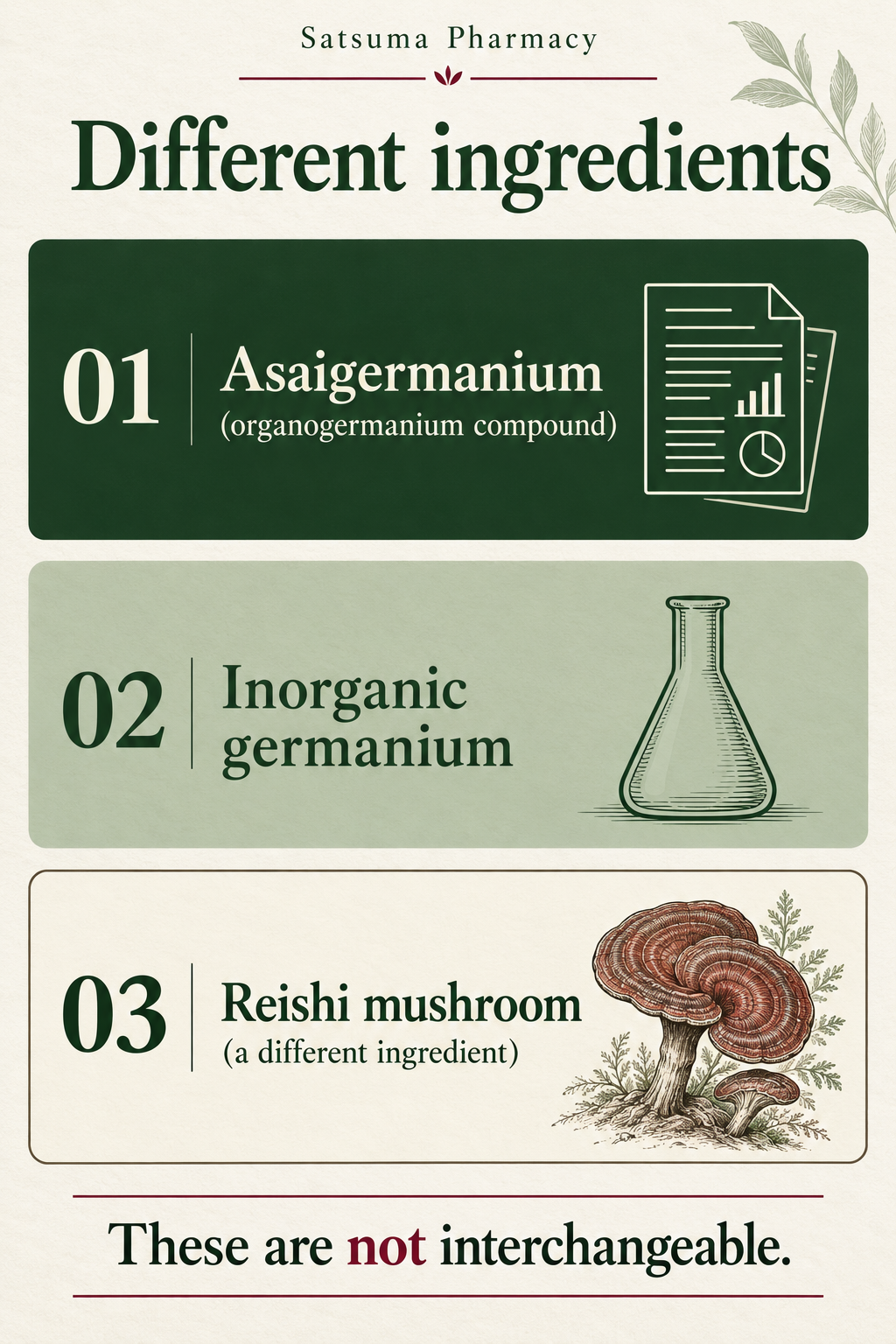
Asaigermanium is an ingredient manufactured by Asai Germanium Research Institute for use in products such as dietary supplements. It is not a name for all organic germanium compounds, and it is not extracted from reishi mushrooms. Here, Satsuma Pharmacy explains the ingredient, the research, our exchanges with Dr. Atsushi Nakamura, and what to consider when choosing a product.
Organic, inorganic and Asaigermanium: what is the difference?
According to the manufacturer, the starting material is purified polycrystalline germanium, obtained from germanium found in coal or ores. It is converted into an organic germanium compound through the company’s manufacturing process—not extracted from reishi or ginseng. Manufacturer’s FAQ: origin and raw material (Japanese)
| Term | What it means |
|---|---|
| Inorganic germanium | Compounds such as germanium dioxide (GeO₂). Their structures differ from Asaigermanium. |
| Organic germanium | A broad group of compounds with a direct bond between germanium and carbon. It includes different substances. |
| Asaigermanium | A water-soluble organic germanium ingredient manufactured by Asai Germanium Research Institute. |
Asaigermanium belongs within the organic germanium group; these are not three equivalent categories. Here, “organic” describes chemistry, not organic farming or a natural, plant-based origin. Start by checking the ingredient name and manufacturer, rather than relying on the name alone.
How is it related to reishi and ginseng?
Analytical studies have detected germanium in samples of reishi and ginseng. The amounts vary between samples and growing conditions. Elemental analysis of reishi / Germanium content in ginseng
This may be an interesting connection for readers familiar with traditional herbal materials. However, measuring an element in a sample is different from identifying a manufactured compound. The properties of reishi or ginseng cannot be explained by germanium alone, and Asaigermanium should not be treated as a substitute for reishi.
What has research found so far?
Rather than reducing research to “it works” or “it does not,” it helps to ask what substance was tested, in whom, and what was measured. Cell experiments, human studies and animal safety comparisons answer different questions.
Cell research: exploring interactions with biological molecules
A 2022 study examined THGP, a hydrolysis product of Ge-132 manufactured by Asai Germanium Research Institute, in cultured human-derived cells. Under specific stimulation conditions, secretion of the inflammatory signalling molecule IL-1β and other responses were suppressed, and interactions with ATP were investigated. This was a laboratory study of cellular mechanisms, not a trial of symptom improvement in people taking capsules. Original study: Azumi et al. (2022)
Human research: an exploratory study, not a definitive answer
A study published in 2025 followed 12 healthy adults who consumed a food product containing Asaigermanium for four weeks. Changes were reported in some blood markers related to immune function. However, this was a small study without a control group. It did not establish disease prevention or improved well-being. The change in triglyceride levels was not statistically significant.
Researchers from the ingredient manufacturer participated, and the company supplied funding and study products. The findings are part of the research picture, but controlled studies and further evidence are needed to assess benefits for consumers. Original study: Kawakami et al. (2025, PDF)
Animal research: distinguishing different germanium compounds
In a 1991 comparison lasting 24 weeks in rats, kidney damage was observed in the germanium dioxide (GeO₂) group, while similar findings were not observed in the group receiving the Ge-132 used in that study. This illustrates why the compounds must be considered separately. It cannot be read as a study of the capsules currently sold by our pharmacy. Original study: Sanai et al. (1991)
Understanding research and deciding whether a product is appropriate for you are related, but different, steps. Your current health and how you intend to use a product matter—not just the number of studies or the scientific terminology.
What should you check about quality and safety?
In 2019, Asaigermanium was registered as a food ingredient under the Japan Health and Nutrition Food Association’s voluntary safety assessment certification and registration system. This is information about the ingredient; it is not approval as a medicine or a guarantee of safety for everyone. Association’s registration list (Japanese)
Check the ingredient name, manufacturer and brand mark identified by the manufacturer, together with the label on the actual product.
Kidney and liver injury have been reported with germanium-containing supplements. Reports include products described as organic germanium, so “organic” alone is not a sufficient basis for judging safety. Safety information from Japan’s national research institute (Japanese)
Follow the product’s suggested intake rather than assuming that more is better. Consult a doctor or pharmacist before use if you have concerns about kidney function, are receiving medical treatment, or are pregnant or breastfeeding. Stop using the product and seek advice if you notice changes in your health.
Our exchanges with Dr. Atsushi Nakamura and the pharmacy’s lecture event
The Organogermanium Study Group brings together physicians, dentists and veterinarians to share knowledge about organic germanium. Its representative is Dr. Atsushi Nakamura, director of Nakamura Clinic in Kobe. It is a separate organisation from the ingredient manufacturer, Asai Germanium Research Institute. Study group members (Japanese)
Satsuma Pharmacy’s president, 野口裕司, has exchanged information with Dr. Nakamura. In November 2023, the pharmacy invited him to speak at a lecture event it organised. Alongside ingredient and safety information, these professional exchanges form part of the background to our introduction of this ingredient.
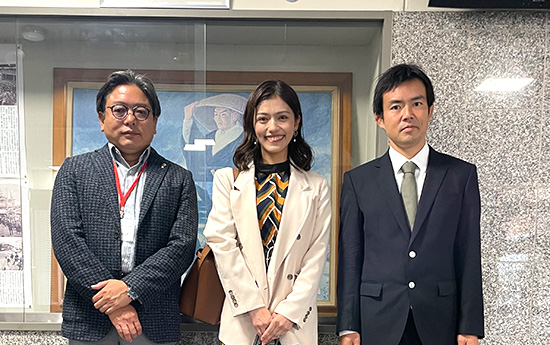

These photographs document the event and professional exchanges. They do not indicate medical review of this article or a guarantee of the product’s effectiveness or safety.
Before discussing a product, we would like to hear about you
In Kampo consultations, we ask not only about a particular concern but also about everyday matters such as eating, sleeping, bowel habits and feeling cold. We take the same approach when discussing supplements. Before adding something because of its reputation, it helps to review what concerns you and what you already do.
- What is your concern? When did it begin, and when does it trouble you? Are you looking to maintain general health, or do you have symptoms that need medical assessment?
- What are you using now? Prescription medicines, Kampo medicines, over-the-counter medicines and supplements. Your medication record or photographs of the products can help.
- Does it fit your daily life? Consider ease of taking it, cost and your routine. Bring your questions before deciding to buy.
Our consultations consider both your individual circumstances and the information about ingredients and research. We can discuss whether to use a supplement while you continue any necessary medical care.
Frequently asked questions
Can I take it with Kampo or prescription medicines?
This depends on the medicines and your treatment. An individual review should consider your health, intended use and intake as well as the combination of products.
How soon should I notice a difference?
We cannot promise an effect or a timeframe that applies to everyone. Rather than increasing the amount because you notice no change, review your reasons for taking it and discuss whether to continue.
Can I contact the pharmacy from elsewhere in Japan?
Telephone and enquiry-form contact options are available. Please provide the product name and details of medicines and supplements you use. The linked product and enquiry pages are in Japanese. Please check language availability when contacting the pharmacy.
Three checks before buying
- Confirm the ingredient name and manufacturer.
- Follow the suggested intake on the product.
- Discuss your health conditions, medicines and other supplements.
Product information and enquiries
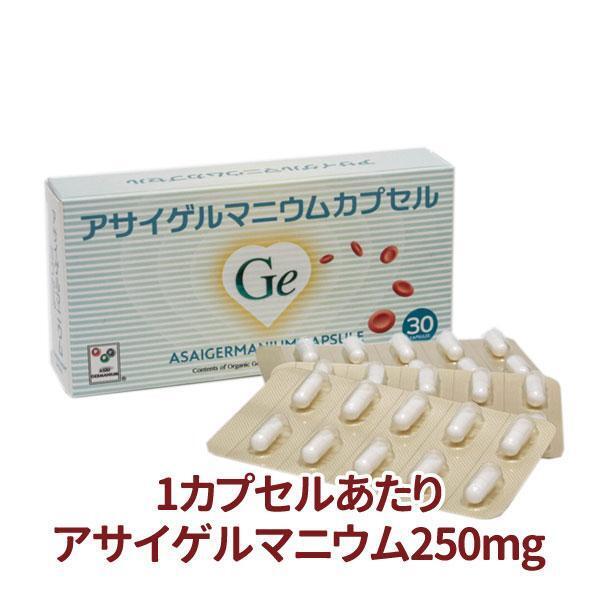
Asaigermanium Capsules, 30 capsules — listed as アサイゲルマニウムカプセル 30カプセル[ビレモ]. Each capsule contains 250 mg of Asaigermanium. The listed price is JPY 14,040 including tax; shipping is extra. The official product page suggests approximately 1–2 capsules daily, making a pack approximately a 15–30-day supply at that intake. Checked on 30 October 2026. Please check the Japanese product page for current price, availability and labelling.
Do not use study doses as instructions for taking the retail product. You can ask the pharmacy about what to consider before deciding whether to use it.
Product details and availability (Japanese)
Product enquiry form (Japanese)
Telephone in Japan: 0120-159-900
This product is a dietary supplement, not a medicine intended to treat or prevent disease.
Further manufacturer information: organic and inorganic germanium / Asaigermanium overview (Japanese).